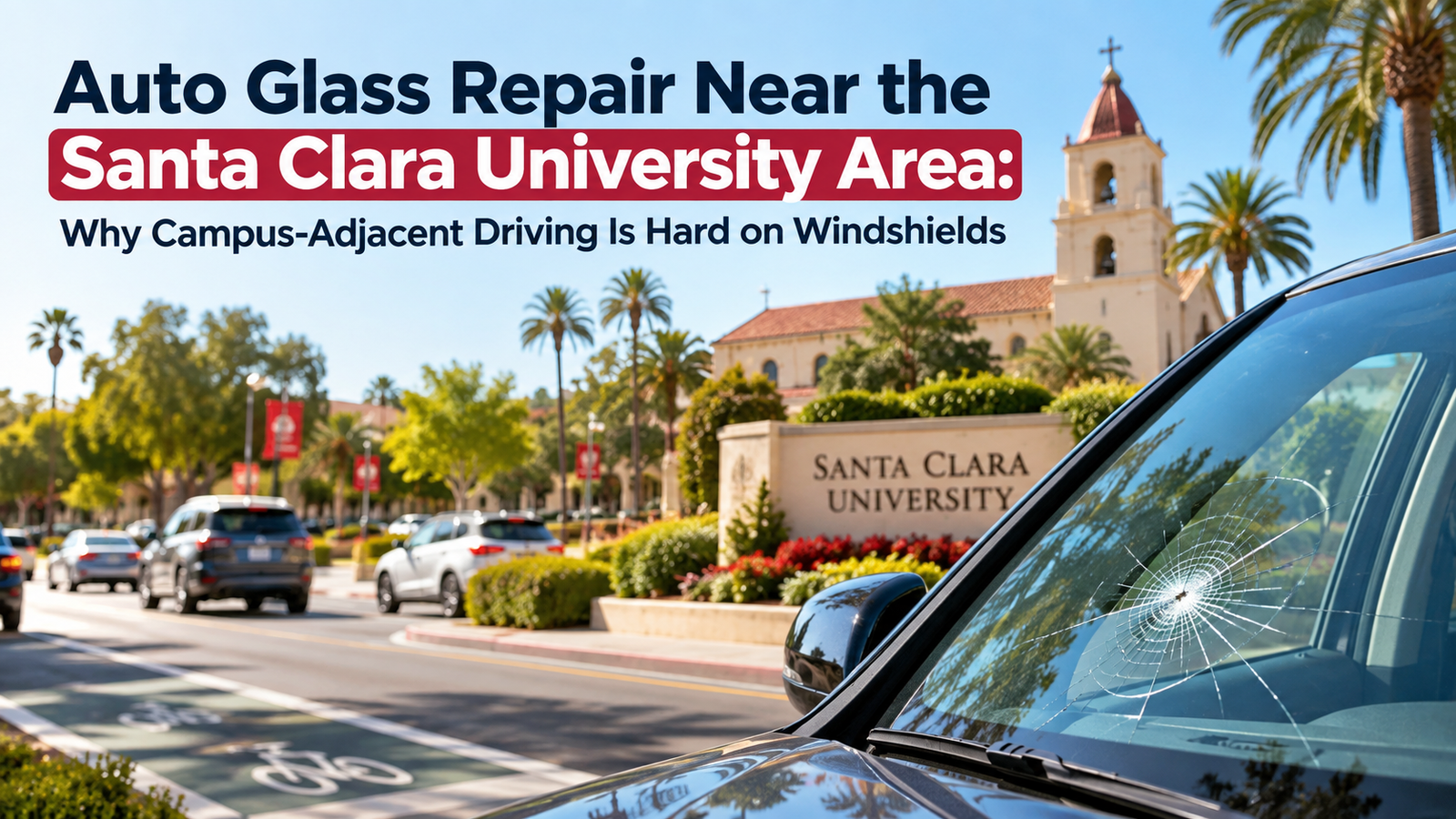
Some parts of a city put more stress on car glass than others, and the streets around a university campus are a good example. Within a few blocks there can be a historic mission, a busy arterial, student housing, restaurants, bike lanes, shaded side streets, and a commuter rail line. Cars in that kind of setting are parked tightly, started and stopped often, and exposed to a mix of debris that a quiet cul-de-sac never sees.
This article looks at auto glass repair santa clara university area from the perspective of that environment. It explains why windshields and other vehicle glass take the kind of damage they do around a campus-adjacent neighborhood in Santa Clara, how different types of damage behave, how repair and replacement decisions are usually understood, and what everyday habits reduce the risk of problems. It is written as general information for drivers who live, study, work, or simply pass through the area near Santa Clara University.
The Setting: What Makes This Area Distinctive
The district around Santa Clara University has a character that is different from both a downtown core and a residential suburb. The campus and the old mission grounds sit along The Alameda, which follows the historic El Camino Real route and carries steady traffic between San Jose and the rest of the Peninsula. Nearby streets mix older single-family homes, apartments, and rental houses with small businesses and restaurants. The Caltrain corridor runs close by, and Highway 101, Highway 880, and Lawrence Expressway are within a short drive.
Several features of that environment matter for vehicle glass.
Dense parking. Students, staff, visitors, and residents compete for street spaces. Cars sit nose to tail, doors open into traffic, and vehicles are moved often. The result is more exposure to minor impacts, dropped objects, and parking-lot hazards.
Mixed traffic. Cyclists, scooters, pedestrians, delivery vehicles, and buses share the same streets. Sudden stops and tight maneuvering are routine.
Tree-lined streets. Mature trees provide welcome shade, but they also drop leaves, seed pods, sap, and branches onto parked cars.
Construction and maintenance. Campus projects, utility work, and street repairs introduce gravel, dust, and loose material onto roads.
Commuter patterns. Many drivers leave the neighborhood each day for the highways, which means a lot of freeway driving where the real danger to glass lies.
How Vehicle Glass Gets Damaged
Windshield damage is rarely a mystery once the causes are understood. Most of it falls into a few categories.
Road debris. Small stones and gravel kicked up by the tires of the vehicle ahead are the leading cause of chips. On freeways the speed difference makes even a pebble strike with surprising force. Trucks carrying uncovered loads and construction vehicles are common sources.
Temperature stress. Glass expands and contracts with heat and cold. A windshield that is hot from the sun and then sprayed with cold water, or one that is cold overnight and blasted by a hot defroster, experiences uneven stress that can extend small flaws into cracks.
Impact from objects. Branches, fallen fruit, sports balls, and thrown items can hit parked or moving cars. In areas with trees and students, this is not unusual.
Parking incidents. Bumps, door dings, bike handlebars, and ladders or roof cargo can strike glass directly or flex the body enough to stress it.
Vibration and body flex. Potholes, uneven pavement, and railroad crossings send repeated shocks through a vehicle, and an existing chip can spread over time.
Vandalism and break-ins. Side and rear windows are the usual targets in areas where cars are left on streets overnight.
Wear. Years of wiper blades and road grit leave fine scratches and pitting that reduce clarity, especially in glare.
Understanding Different Types of Damage
Different damage patterns call for different responses, and recognizing them helps make sense of what technicians describe.
Chips. A chip is a localized impact point on the outer surface. Common shapes include bullseyes, half-moons, and star breaks. Small, clean chips are the best candidates for repair.
Cracks. A crack is a line that extends across the glass. Short cracks may be repairable, while long ones generally lead to replacement. Cracks that start at the edge of the glass behave particularly poorly, because the edge is under more stress.
Combination breaks. These show both a crushed center and radiating legs, and they are more complex than a simple chip.
Pits and surface scratches. Fine pitting from sand and grit is a surface problem and does not usually extend into cracks, but it can create glare.
Delamination and edge separation. When the plastic layer inside laminated glass begins to separate, it can create hazy patches or bubbles near the edge.
Shattered tempered glass. Side and rear windows are usually tempered glass, which breaks into small granules instead of cracks. A tempered window cannot be repaired once it breaks and must be replaced.
How Repair Works, in General Terms
For chips and short cracks in a laminated windshield, repair relies on injecting a clear resin into the damaged area and curing it with ultraviolet light. The resin has optical properties very close to glass, so it fills the fractures, restores much of the strength, and reduces the visibility of the damage.
The process generally involves cleaning the damaged spot, creating a vacuum to draw out air and moisture, injecting resin under pressure, curing it with a UV lamp, and then scraping and polishing the surface. A well-done repair often leaves only a faint mark where the impact occurred.
Repair is most effective when it is done early, before dirt, water, and further stress have worked into the damage. It also works best on chips that are not too large and not too close to the edge of the glass.
When Replacement Is the More Sensible Path
Repair has limits. Replacement is usually considered when:
- The crack is long, often longer than several inches
- The damage reaches the edge of the glass
- The damage is directly in the driver’s line of sight
- Both layers of glass are penetrated
- Many chips are clustered together
- The chip is contaminated with dirt or moisture to the point that resin cannot flow in
- The glass has delaminated or is heavily pitted
California has rules about driving with a windshield obstructed or damaged in a way that blocks the driver’s view, so damage in the main viewing area deserves particular attention.
Camera and Sensor Considerations
An increasing number of vehicles, including many popular compact cars used by students and commuters, are equipped with advanced driver assistance systems. These systems often rely on a forward-facing camera mounted behind the windshield near the rearview mirror. The camera supports features such as lane departure warning, automatic emergency braking, and adaptive cruise control.
This matters for glass work in two ways. First, damage in the area in front of the camera can interfere with how the system sees the road. Second, if the windshield is replaced, the camera typically needs to be recalibrated so that it is aimed correctly. Calibration can be static, performed with targets while the vehicle is stationary, or dynamic, performed by driving on appropriate roads, or both depending on the manufacturer’s specification.
Drivers of newer vehicles are well served by knowing whether their car has a windshield-mounted camera, since it affects how glass issues are approached.
Weather and Climate in the Santa Clara Valley
Santa Clara sits in a valley with a Mediterranean climate: warm to hot, dry summers and mild, wetter winters. Summer afternoons can reach the 90s, and parked cars can heat up far beyond the air temperature. Winter mornings can be cool and damp, and fog is not unusual during certain stretches.
These conditions have specific effects on glass.
Heat. A windshield that has been baking in the sun can reach very high surface temperatures. Switching on cold air conditioning at full blast creates a sharp temperature gradient across the glass that can extend a chip.
Cool damp mornings. Condensation and moisture can enter a chip, and a sudden blast of hot defroster air onto cold glass produces stress.
Rain. Water entering unrepaired chips carries dirt into the damaged area and makes later repair less effective.
Wind and dust. Dry weather can blow dust and grit across roads, adding to pitting over time.
The practical guidance is simple. Let the cabin temperature change gradually, park in shade or a garage when possible, and cover a chip with clear tape if repair will be delayed.
Everyday Habits That Reduce Glass Damage
A few routines go a long way in a busy, campus-adjacent area.
- Keep a safe following distance. Staying well behind trucks and other vehicles reduces exposure to flying debris.
- Avoid parking beneath dropping hazards. Trees that shed heavily, construction scaffolds, and overhanging branches can damage glass.
- Use sunshades in summer. They reduce interior heat and the temperature swing when the cabin is cooled.
- Wash gently. Hand washing or soft-cloth methods are easier on chipped glass than strong jets.
- Replace worn wipers. Old blades trap grit and scratch the glass.
- Close doors gently. A hard slam sends a pressure pulse that can extend an existing crack.
- Inspect glass regularly. A quick look each time the car is washed or refueled catches small chips early.
- Do not leave valuables in view. Reducing the temptation to break into a car protects side and rear windows.
Side and Rear Glass in a Campus Area
Windshield issues get the most attention, but side and rear windows are important too. In dense urban and campus-adjacent neighborhoods, vehicle break-ins are a recurring concern, and smashed side windows are the typical result. Tempered glass shatters into small granules, which scatter inside the vehicle and in door cavities.
If a side window is broken, a few steps help limit further damage. Remove glass pieces from seats and floor carefully, cover the opening with heavy plastic and tape to keep rain and dust out, and avoid rolling a damaged window up and down, which can drop fragments into the door.
Rear windows often contain defroster grids and antennas that are bonded into the glass, so replacement involves more than just glass. The electrical connections need to be correct.
Mobile Versus Shop Settings in a Neighborhood Like This
Many drivers who live in apartments, shared houses, or dormitories do not have a garage or private driveway, and their cars are parked on the street or in a shared lot. That has led to wide use of mobile glass service, in which the work is done where the vehicle is parked.
From an informational standpoint, the main considerations are the same as anywhere. Chip repair is quick and portable and can be done in nearly any parking space with good light. Windshield replacement is more sensitive to dust, moisture, and temperature, because the adhesive bond depends on a clean, dry surface. Adequate space to open doors and handle glass is also helpful. In-shop work offers a controlled environment and is often preferred for more complex calibration needs.
Neither approach is inherently better. The right fit depends on the type of damage, the weather, the vehicle, and the available space.
Common Misunderstandings
“A small chip does not matter.” Small chips can spread, and they are easiest to repair when they are caught early.
“Clear tape fixes a chip.” Tape protects against dirt and moisture but does not repair the glass.
“Only freezing weather cracks windshields.” Heat and rapid temperature change also cause cracks.
“Side windows can be repaired like windshields.” Tempered glass cannot be repaired and must be replaced once broken.
“Replacement glass is all the same.” Glass can differ in optical quality, features, and compatibility with sensors and brackets.
“I can ignore a crack as long as I can see.” A growing crack weakens the glass and may violate rules about driver visibility.
Frequently Asked Questions
Why do windshields get damaged so often near busy campus areas?
Dense parking, mixed traffic, nearby construction, and tree debris all increase exposure to impacts. Commuter routes onto highways add the risk of flying road debris.
Can a small chip be repaired?
Often yes. Small, clean chips that are not too close to the edge can usually be repaired with resin. Early attention improves the result.
How can I tell if a crack is too long to repair?
Cracks longer than several inches, or cracks that reach the edge of the glass, are generally treated as replacement cases, though guidelines vary.
Does hot weather really affect glass?
Yes. Sun-baked glass subjected to sudden cooling or uneven heating can crack, especially if it already has a chip.
Does my car have a camera behind the windshield?
Many newer vehicles do, particularly those with lane departure warning or automatic braking. Checking the owner’s manual or looking for a housing near the rearview mirror can help answer the question.
Is tempered glass repairable?
No. Tempered glass breaks into small granules when damaged and must be replaced.
What should I do if a side window is smashed?
Clear glass fragments carefully, cover the opening to keep out weather, and avoid operating the window until the door cavity has been cleaned.
Can chip repair be done in a street parking space?
Yes. Chip repair uses portable equipment and works in most locations with adequate light and dry conditions.
Final Thoughts
The streets around a university campus ask a lot of a car. Tight parking, mixed traffic, falling debris, commuter freeway miles, and the swing between cool mornings and hot afternoons all add stress to glass that is already doing important structural and safety work. Most damage can be understood as a chain of simple causes, and most of the response can be understood as a series of simple decisions about timing, damage type, and conditions.
For anyone reading about auto glass repair in the Santa Clara University area, the most practical takeaways are to notice damage early, protect chips from dirt and moisture, avoid sudden temperature changes, and understand how a windshield camera might affect the way glass work is approached. Small habits, repeated consistently, help keep vehicle glass clear, strong, and doing its job.